hthrjt2017@gmail.com
Wastewater reuse and treatment project of a potato chip processing enterprise in Kunming
- release date: 2022-08-20 10:50:00
- author: Hongtai Huairui
- Reading: 4963
key words: Kunming, potato chip processing, wastewater reuse
Hongtai Huarui Technology Group welcomes your visit. We have been dedicated to the environmental protection and governance industry for over a decade! We look forward to a cooperation with you!


+86 19102876179 +86 400-669-0860

key words: Kunming, potato chip processing, wastewater reuse
project overview
This potato chip processing enterprise is a company that mainly produces a series of fried potato chips. The company is committed to the development, production and sales of natural potato chips. The potato chips produced by this company are refined from high-quality Ma Lingji in the alpine mountainous areas of Yunnan. They are all natural, pollution-free and original. They are a snack food containing multiple vitamins and amino acids, rich in nutrients, and suitable for all ages. Since its launch, the natural potato chips produced by this company have become the first brand of similar products in the province with its excellent product quality, multi-specification and multi-flavor market segmentation and efficient and rigorous marketing methods, and have been deeply loved by consumers. The company has the world's advanced complete set of fried potato chip equipment, with rigorous and scientific production processes and specifications and strict production process control. Relying on Yunnan's high-quality Malingji resource advantages, the natural potato chips produced have passed the organic food certification of the State Environmental Protection Administration.
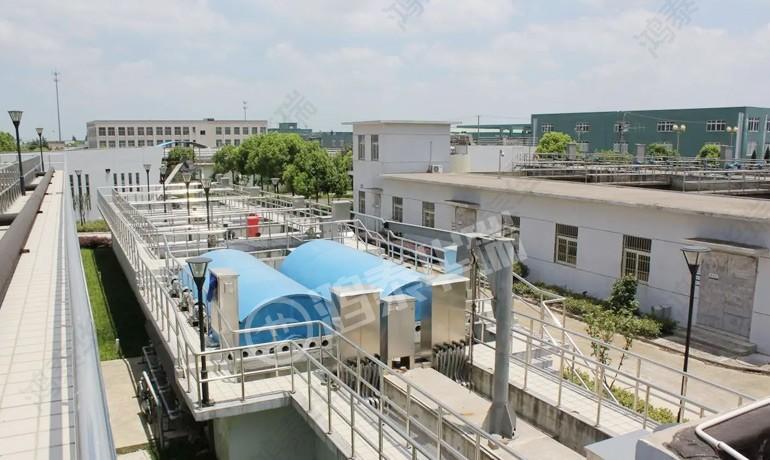
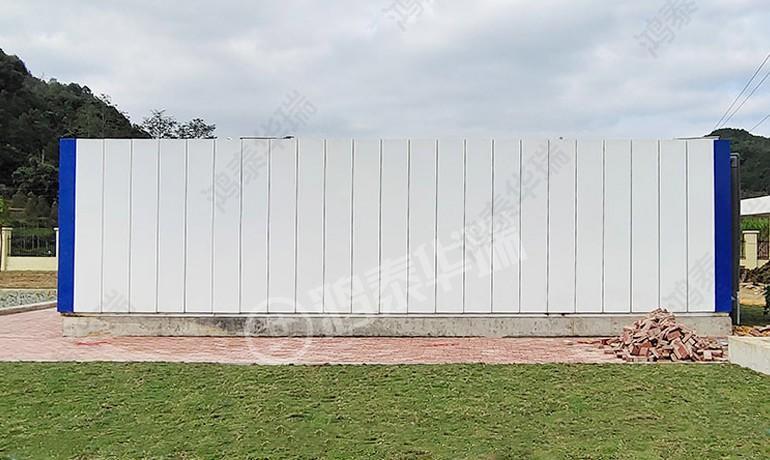
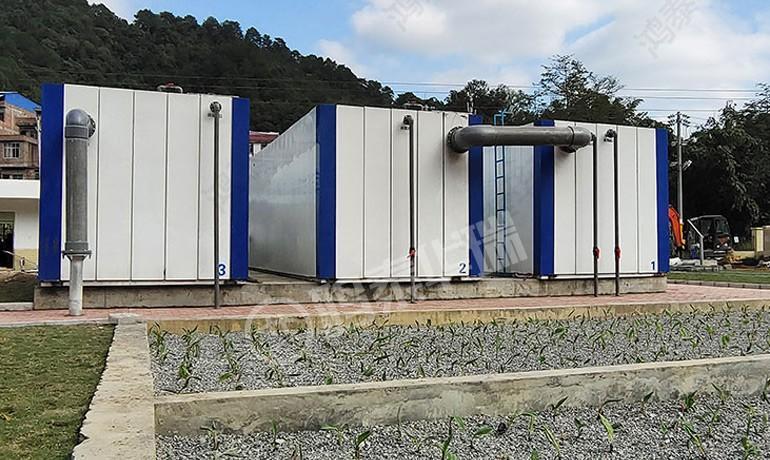
The company's potato chip processing wastewater mainly comes from potato cleaning, slicing rinsing and hot washing during potato processing. The pollutants in the wastewater mainly include potato skins, potato chips, sediment, starch, etc. This kind of wastewater has the characteristics of high suspended solids and organic matter content, and has good biodegradability. The wastewater treatment scale is 600m3/d, and the design adopts a combined process of anaerobic + aerobic + air flotation + advanced treatment. The effluent water quality meets the requirements of "Urban Sewage Reutilization of Urban Miscellaneous Water Quality"(GB/T18920 - 2002) for greening, flushing, road cleaning, etc., and is reused for greening of the factory area. The total installed capacity of the wastewater treatment system is 109.02kW, and the operating cost is about 1.49 yuan/m3wastewater (excluding depreciation).
Design basis
(1) Various relevant basic information provided by the builder (water quality, water quantity, reuse requirements, etc.);
(2) "Urban Wastewater Recycling and Urban Miscellaneous Water Quality" (GB/T18920-2002);
(3) (Technical Conditions for Water Treatment Equipment) (JB/T2932-1999);
(4) On-site treadmill information:
(5) The spirit of relevant national, provincial and regional regulations, regulations and documents:
(6) Other relevant design specifications and standards.
Design principles
(1) Conscientiously implement the national guidelines and policies on environmental protection, so that the design complies with the relevant national regulations, norms and standards.
(2) Comprehensively considering the characteristics of wastewater quality and quantity, the treatment process selected should be technologically advanced, reliable and reliable, economical and reasonable, flexible and safe to use:
(3) Properly treat and dispose of the sludge and float method generated during the treatment of skin water to avoid secondary pollution
(4) The automatic control system of the wastewater treatment system should be convenient to manage, safe and reliable, economical and practical:
(5) The layout of the wastewater national treatment system should strive to be compact, reduce land occupation and investment, and the elevation layout should adopt a stylistic layout as much as possible. Make the most of underground space:
(6) Properly consider the development prospects of the enterprise and leave room for design.
(7) Strictly design according to the defined conditions of the construction party to adapt to the actual situation of the project.
Source of pollution
Mainly from potato cleaning, slice rinsing and hot washing processes in the potato processing process, the pollutants in the wastewater mainly include potato skin, potato crumbs, sediment, starch, etc.
Processing technology
Wastewater characteristics
The company's potato chip processing wastewater mainly comes from potato cleaning, slicing rinsing and hot washing processes during potato processing, and the wastewater mainly contains pollutants such as starch, sugar, protein, waste acid and waste alkali. The wastewater has a high concentration of organic matter, many suspended solids, and good biodegradability.
Process
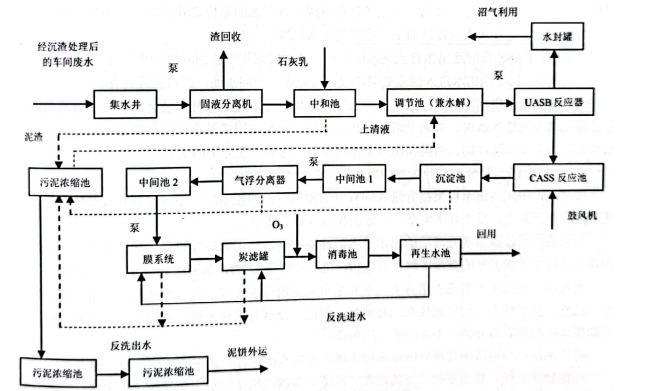
According to the water quality and quantity characteristics of the wastewater of the project, the combined process of "anaerobic + aerobic + air flotation + deep treatment" is designed, and the specific process flow is shown in Figure 2.
Fig. 2 Potato chip processing wastewater reuse treatment process
Process description
In the water collection well, the workshop after the treatment of the original sediment treatment system of the enterprise produces skin water spontaneously flows into the water collection well, and then is lifted into the solid-liquid separator by the pump.
Handling indicators
Based on the information provided by the construction party, the total design wastewater volume is 600m3/d, the average processing capacity is 25m based on 24 hours of operation per day3The eight design wastewater influent water quality indicators are shown in Table 1.
Table 1 Design wastewater influent water quality
|
project |
CODCR/(mg/L) |
SS/(mg/L) |
Candlestick/(NTU) |
NH3-N/(mg/L) |
Phosphate/ (mg/L) |
pH |
|
Influent water quality |
5 000-8000 |
200 |
100 |
9~15 |
90~130) |
3.5~4.5 |
According to the requirements of the construction party, the treated wastewater effluent meets the "Urban River Water Recycling and Urban Miscellaneous Water Quality"
(GB/T 18920-2002) The water requirements for toilet flushing and greening in the standard, the specific water quality requirements for reuse water are shown in Table 2
Table 2 Design wastewater effluent quality
|
project |
BOD5/ (mg/L) |
Chromaticity/degree |
Candlestick/(NTU) |
NH3-N/(mg/L) |
Total E. coli/(pcs/L) |
pH |
|
Reuse water quality |
≤10 |
≤30 |
≤5 |
≤10 |
≤3 |
6~9 |
Previous Article:Beef processing wastewater treatment pro...
Next Article:Pig wastewater treatment

Environmental Protection Information
Selected Recommendations
Recommended Products